
Car buying gets political and the Nordic countries are the pickiest



A large majority want to be able to repair their cars to maximize their lifespan. There is also strong support for ensuring that electric cars can be repaired just as easily as traditional vehicles. But the question is – how easy will that be in the future?
On April 28, 2025, Spain and Portugal went dark. Traffic lights died. Trains stopped. Card payments failed. Within hours, it was clear how fragile everyday life is when society’s systems stop working.
When electricity, trains and payments all grind to a halt, the car is one of the few things a household still controls. With fuel in the tank, you can check on loved ones, shop where stores are still open and stay warm on a cold night.
How Europeans respond
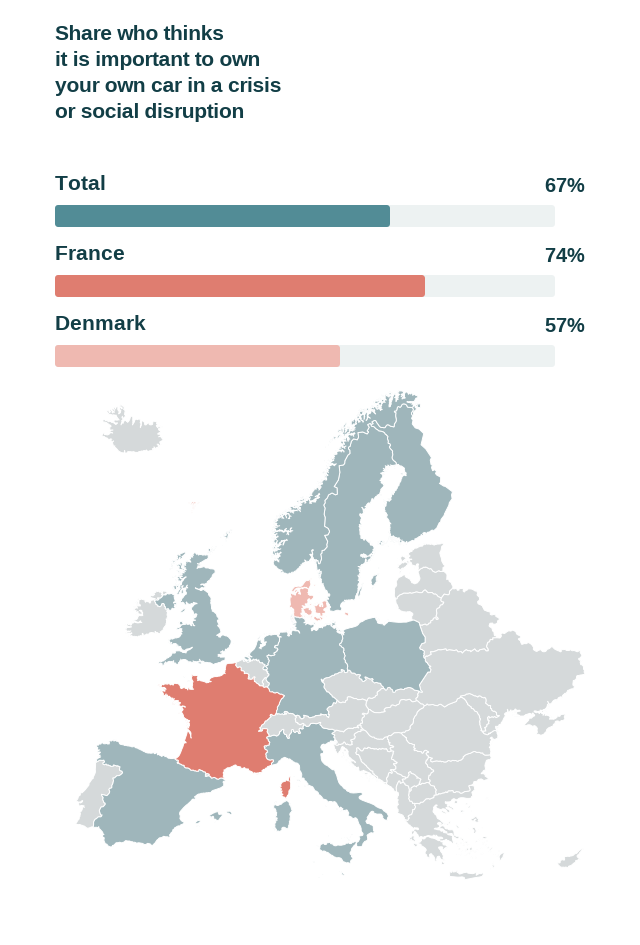
This year’s Mobility Barometer asked people in 11 European countries how important it is to have their own car in a crisis or major disruption. Some 67 percent say it is important, and one in three says it is very important. Just over one in ten do not think it is important.
We also asked whether, over the past year, they had thought more about how they would manage without a car in the event of a crisis or a power outage. Of those asked, 31 percent said yes. About the same share say their views have not changed, and one in four has never given the matter any thought.
Differences between countries
Owning a car is most important in France and the UK, where seven to eight in ten consider it essential in a crisis. It matters least in Denmark, where just over half say so.
In Italy, Poland and Spain, slightly more than one in three have thought more over the past year about how they would cope in a crisis without a car. The share is lowest in the Netherlands (just over one in five) and Finland (just under one in four). The French stand out in another way. One in three has never given coping without a car a thought, more than in any other country.
Steady in the Nordic countries
In the Nordic countries, the questions were first asked last year, and the answers have barely changed. About six in ten consider their own car important in a crisis. Just under one in three has thought more about it over the past year.
MEKO’s mission is to serve all car owners, all models, and all budgets. Our belief in diversity also means that every car owner should be free to choose where to service their vehicle on an open and competitive market. That makes the issue of who controls car data – the key to analyzing and repairing advanced vehicles – a critical question for consumers’ wallets. Our position is simple and clear: the car owner should have the right to their vehicle’s data. He or she should be free to choose an independent workshop as well—one that can do the job just as well, even though it isn’t tied to the car manufacturer.


