
Car buying gets political and the Nordic countries are the pickiest



The car is the most common way to get around in all 11 countries in this year’s Mobility Barometer. By a wide margin. Italians drive the most and in the Nordic countries, car use remains at record levels.
New options have arrived in recent years, from e-bikes and e-scooters to expanded public transit. Yet for everyday trips, the car is still the top choice for most people, whether they live in a big city, a small town or the countryside.
More than eight out of ten people use their car at least once a week, and seven out of ten do so several times a week. This year’s survey adds seven new countries, so for the first time we can see how people use cars across much of Europe. The pattern is the same everywhere – no other way of getting around comes close.
Italians drive the most
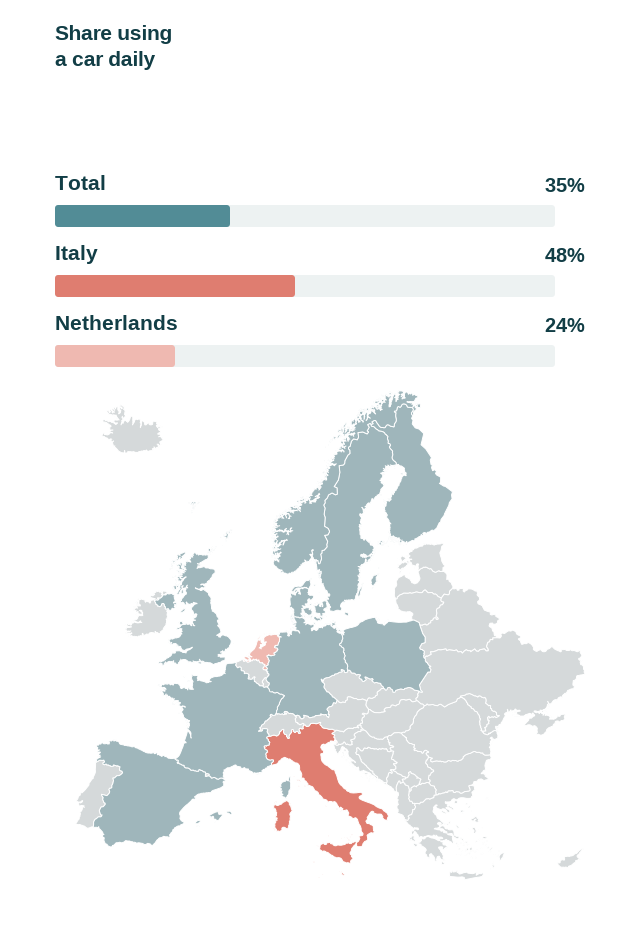
Italians drive the most with nearly half (48 percent) getting in the car on a daily basis. France comes next, where four in ten drive daily. Public transit isn’t a big draw there either; four in ten people rarely or never use it.
At the other end of the scale is the Netherlands, where about one in four drives every day. Cycling is king here, with more than half of residents riding several times a week. Nevertheless, cars are popular even in the Netherlands, and the Dutch use them almost as frequently as Swedes and Finns.
Public transit and bikes complement the car
Public transit is used most frequently in Poland and Spain, where about one in three people use it several times a week. But nearly twice that number drive just as often. In Denmark and Finland, public transit plays a minor role in daily life. In Denmark, bikes account for a large share of trips, second only to the Netherlands.
The pattern is clear: where public transit and bikes are widely used, they complement the car. They don’t replace it.
Nordic region: car use remains at record highs
Since 2022, the Mobility Barometer has tracked car use in the Nordic countries. Over that time, the share of people who drive every day has climbed from one in four (25 percent) to nearly one in three (30 percent). This year’s figure matches last year’s record. The share who drive at least several times a week has also edged up each year. Norwegians drive the most in the Nordic region, followed by Danes.
For most Europeans, the car is far more than one option among many. It’s a natural part of daily life: the commute, preschool pickup, the ride to soccer practice, the visit to relatives. At the same time, cars are becoming increasingly diverse. While gas and diesel cars still dominate, HEVs and EVs are becoming increasingly common. In Norway, more than one in three people has access to an EV.
This year’s Mobility Barometer confirms something the future-of-mobility debate sometimes overlooks: the car holds a very strong position across Europe. E-bikes, e-scooters and public transit play an important role. Most people use them alongside the car, not instead of it. Every day, millions of Europeans get behind the wheel, and in the Nordic countries, car use has now hit a record high two years running.
There’s good reason to expect that to continue. Nordic car use has grown steadily over the past five years and, even in countries where public transit and bikes are used the most, the car is still the most common way to get around. We work every day to be there for people who choose the car as a mode of transport, wherever they live and whatever they drive.


