
Car buying gets political and the Nordic countries are the pickiest



Cities across Europe are introducing low-emission zones. Some are talking about fossil-free city centers. This year’s Mobility Barometer compiled views on a ban on gas and diesel cars in city centers. The message is clear, but one country is going its own way.
Cleaner air and quieter streets are the arguments behind zones like those in London, Paris and Stockholm, which exclude older, more polluting cars from certain areas. In the long term, many places are also discussing car-free or fossil-fuel-free city centers.
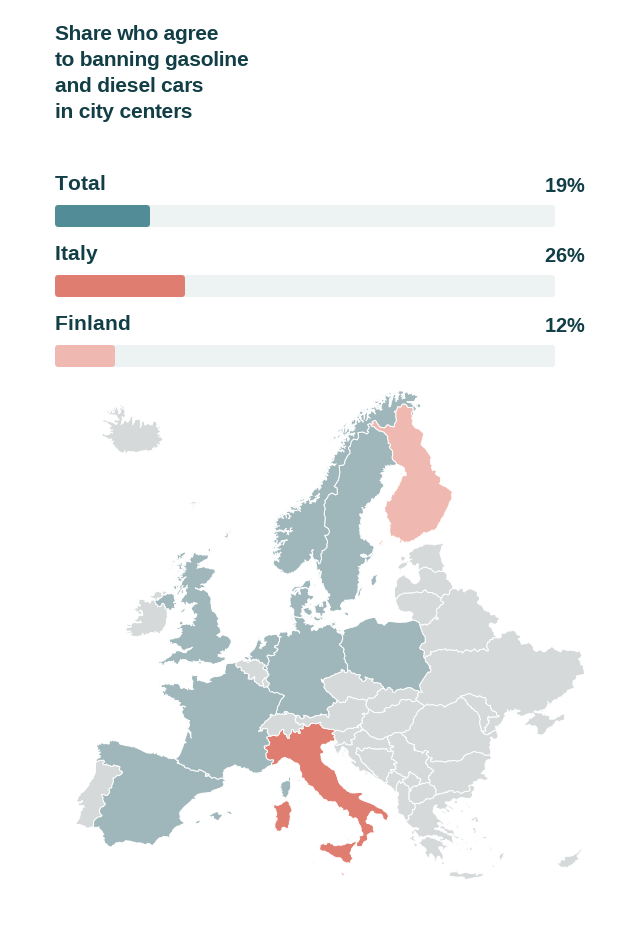
This year’s Mobility Barometer asked whether gas and diesel cars should be banned from city centers. Of those asked, 54 percent disagree and only 19 percent agree. Opponents outnumber supporters by nearly three to one.
Strongest opposition in Finland, Germany and France
Opposition is strong everywhere, but it is strongest in Finland, Germany and France. There, roughly two in three say no to a ban, and nearly half reject the idea outright.
The survey does not ask why, but the question encompasses conflicting interests. Supporters point to cleaner air, less noise and better health in densely populated areas. Opponents worry about how people who live outside the cities and lack good public transit will reach jobs, services and shops in the city center. Both perspectives exist in every country.
Italy stands out
Italy is the country with clearly fewer opponents than the others. Four in ten are against a ban, one in four is in favor and nearly one in three has no firm opinion. Italy has both the highest share of supporters and the highest share of undecided respondents in the survey.
One explanation may be that Italians are used to restrictions. Many Italian cities have long restricted car traffic in their historic centers.
Growing opposition in the Nordic countries
In the Nordic countries, where this question has been asked since 2024, opposition to a ban has grown every year. Two years ago, half were against it. Today, it is more than half. The share who reject the idea outright has risen from just over one in four to more than one in three. The shift is clearest in Finland. Support hasn’t moved. It has remained steady at just under one in five.
Most of the cars on European city streets today will still be there for years to come. In this year’s Mobility Barometer, one in three Europeans says a car should be driven as long as it works, and one in five has postponed or canceled a car purchase in the past three years for financial reasons. So cities will change only as fast as the car fleet is renewed, and that pace is determined by household finances.
Until then, the cars already on the road need to be safe and in good condition. A well-maintained car with working brakes, tires and emission controls is better for its driver and for the city’s air quality. That is where we do our work every day, in workshops across northern Europe, on cars of every age and make.


