
Car buying gets political and the Nordic countries are the pickiest



Many new cars already keep a safe distance, read road signs and warn drivers when they are getting tired. Handing the wheel to a computer is something else entirely. This year’s Mobility Barometer shows that Europeans have a clear limit on how much technology should dictate their lives.
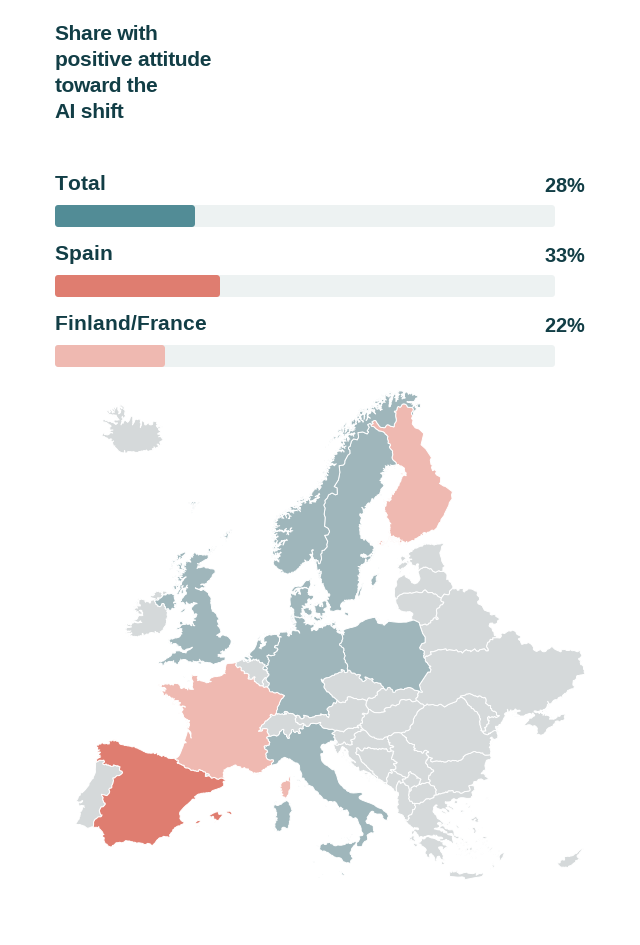
Driver-assistance features like adaptive cruise control, lane assist and parking assist are now common in new cars. The next step is AI-based systems that take over more and more of the decisions drivers once made themselves.
Many Europeans view this with skepticism. Some 38 percent oppose AI taking over driving tasks, while 28 percent support it. Furthermore, nine in ten trust a human behind the wheel more than a computer.
The British are most skeptical
Rather than privacy, the concern is about technology failing at the wrong moment. Two in three fear the system will make mistakes or wrong decisions. More than half fear becoming so dependent on it that they lose the ability to drive on their own.
Concern runs highest in the UK, Finland and France, where nearly half of respondents are negative. In Poland, Italy and Spain, opinion is evenly split between those who are positive and those who are negative.
Yes to monitoring, but no to data collection
Many people are fine with the car keeping an eye on them. Soon, new cars in the EU must be able to detect whether the driver is watching the road. Nearly half of Europeans (48 percent) back the requirement, while 20 percent oppose it. In Italy, six in ten support it. A system that warns drivers when their eyes stray from the road is clearly seen as a feature that helps the driver stay in control.
However, collecting driver data to offer services meets more resistance. Here, 43 percent say no and only 26 percent say yes. What matters is the purpose. While safety gets a pass, data collection for services does not, at least not to the same extent. Finns are the most critical, with six in ten saying they do not think it is okay for cars to collect data about them in order to improve services.
Growing skepticism in the Nordic countries
In the Nordic countries, where this question has been asked since 2024, skepticism has grown every year. The share opposed to AI taking over driving tasks has climbed from 31 to 39 percent, and more people than before would rather trust a human than technology.
Drivers are happy to rely on technology, as long as they are the ones behind the wheel.
Cleaner urban environments are an important goal – but are strict bans really the most sustainable way to get there? The Mobility Barometer shows that many see risks in banning gasoline cars in city centers, perhaps because there is a perception that such measures could limit people’s mobility and access to work, services, and leisure.
To strengthen public support for the transition, accessible and attractive alternatives need to be highlighted. These could include more affordable and durable electric cars, along with a well-functioning and easily accessible charging infrastructure.
MEKO sees a clear role to play in this transition – by ensuring that all types of vehicles can be maintained, repaired, and kept running in a sustainable way, regardless of technology.


