New findings from Norway debunk the myth of the maintenance-free electric car
03 February 2026
It rolls more quietly, feels more modern, and promises simpler car ownership. But beneath the surface, a new government vehicle inspection report from Norway shows that electrification is not only changing how we drive—it is also changing how our cars wear and how they need to be maintained.
In just a few years, the electric car has gone from a vision of the future to an everyday presence on roads across several European countries. For many drivers, this has meant fewer workshop visits, lower operating costs, and the sense that the car almost takes care of itself. At the same time, vehicle inspections tell a more nuanced story — one that rarely shows up in daily driving but becomes clear under close examination, and one that punctures the myth of the maintenance-free electric car.
New figures from Norway’s public roads authority show that electric cars receive nearly twice as many inspection remarks as comparable fossil-fuel cars of the same age*. As many as 30 percent of ten-year-old electric cars had faults at inspection, compared with just 16 percent of gasoline cars. These issues are not about how the car is powered, but about components that wear regardless of drivetrain—such as brakes, suspension, tires, and lighting.
“This is not the first time these signals have appeared. On the contrary, this is yet another indication of a pattern that has become increasingly clear as electric cars become more common and older. When technology changes, wear patterns change as well. That places new demands on maintenance, expertise, and expectations of modern car ownership,” says Andreas Forslund, vehicle technology expert and Mobility Solutions Manager at MEKO.
Fewer service visits — but not less wear
Many people see the electric car’s biggest advantage as its reduced need for traditional maintenance. No oil changes, fewer moving parts, and longer service intervals. But this is also where a new challenge emerges.
Longer service intervals mean fewer opportunities to detect wear in time. Because electric cars largely slow down using the electric motor, the conventional brakes are used less, which can cause them to rust or seize. In addition, tires and suspension components wear faster, as electric cars are generally heavier than fossil-fuel vehicles.
The result is that problems often go unnoticed in everyday driving and are only discovered when the car reaches the inspection station. This is where the gap arises between expectation and reality.
“Wear doesn’t disappear. Electric cars wear in ways many people don’t expect, which means maintenance needs to be adapted to new wear patterns,” Andreas Forslund says.
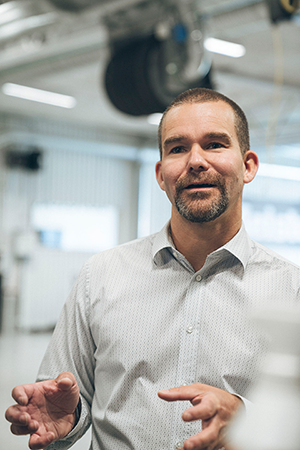
Andreas Forslund, vehicle technology expert and Mobility Solutions Manager at MEKO.
Confirmation of what MEKO has seen for a long time
For MEKO, the Norwegian data is not surprising. Rather, it confirms what has become increasingly clear as the vehicle fleet electrifies: fewer service occasions require more conscious and preventive maintenance.
“Electrification makes the car simpler in some ways, but it does not make maintenance irrelevant. On the contrary, we need to get better at monitoring the actual condition of vehicles over time,” says Andreas.
As cars evolve, so does the role of the aftermarket. It is no longer just about fixing faults—it is about understanding new wear patterns, interpreting data, and helping car owners do the right thing at the right time.
Sustainable mobility is more than electricity
Electrification is a key part of the transition to a more sustainable transport system. But sustainable mobility is also about vehicles being safe, reliable, and functioning properly—year after year. The aftermarket plays a crucial role in that transition. “At MEKO, we are working intensively to meet this development. Today, we service and repair electric cars in much the same way as gasoline cars. Our workshop chains —Mekonomen, MECA, and Automester — are investing heavily in skills and equipment to ensure that electric cars are safe to own, drive, and maintain throughout their entire lifespan,” Andreas says.
Electrification is changing mobility, but the need for maintenance remains. For MEKO, the conclusion is clear: when mobility changes, our view of maintenance and service must change with it.
Owning a car should be simple and worry-free, whether it’s a quick repair or scheduled maintenance. With Mekster, MEKO’s e-commerce platform, car owners get all spare parts, accessories, and tools in one place. The platform offers both well-known brands and affordable alternatives, making it easy to find exactly what’s needed.
Henrik Pettersson leads MEKO’s private label initiative Exclusive Brands with energy and precision. Since 2019, he has built clarity and structure in the assortment and pricing strategy, launched new product lines, and established premium offerings across multiple markets. His day-to-day work spans strategic leadership at headquarters and hands-on support in the business areas — always focused on delivering results together with colleagues.
What if servicing a car were as natural to do yourself as replacing a light bulb? It sounds like a distant reality, but in 2025 students have shown that this could be a possible future. With the ambition to strengthen car owners’ full right to their vehicle—including the right to choose who performs service and repairs—students from Eindhoven University of Technology have developed ARIA (Anyone Repairs It Anywhere), a modular electric car designed to be repaired by the owner without specialized expertise.